AI Infrastructure for Canadian Small Businesses: Free Finder (2026)
Independent Canadian business guide
Answer four questions to see whether your business is better suited to secure AI software, a managed Canadian cloud project, private AI, or rented computing power.
Research last reviewed: September 29, 2026
Canadian Business AI Infrastructure Finder
This is a starting-point tool, not a quote or legal opinion. Choose the answer that best describes the first project you want to complete. If you have several projects, run the finder once for each one.
Your likely starting point
Why this fits
What to investigate
Provider types to compare
Avoid for now
Before acting on a result: industry rules can change the answer. Healthcare, financial services, legal services, insurance, education, government work, and businesses handling information for large clients may have additional obligations. The finder deliberately does not ask for your industry or any company data.
Quick answer
Most Canadian small businesses do not need to buy GPUs or run their own AI servers. If you want help writing, summarizing, taking meeting notes, or working with ordinary office files, start by assessing a business AI subscription with proper administrator controls. If you need to search confidential records, build an AI customer assistant, or keep processing in Canada, a managed Canadian-region cloud or private deployment may deserve a closer look.
The expensive infrastructure conversation normally starts only when a company is developing an AI product, running a large workload, training or fine-tuning models, or meeting unusually strict privacy, contractual, or sovereignty requirements.
The four levels of business AI infrastructure
“AI infrastructure” sounds like racks of servers, but the term covers several very different purchases. A small business should normally start at the lowest level that can solve the problem.
1
Business AI software
A finished service for writing, summarizing, meetings, email, and office files. The provider runs the infrastructure. You manage accounts, access, settings, and policy.
Typical fit: most first projects.
2
Managed AI solution
A partner configures document search, a private assistant, or workflow automation using managed services. You still do not own the underlying GPUs.
Typical fit: internal knowledge or a narrow customer assistant.
3
Cloud AI platform
Developers combine model APIs, databases, identity, search, monitoring, and application code. The cloud provider supplies capacity as it is used.
Typical fit: a custom application or product.
4
Private or sovereign compute
Dedicated, private-cloud, Canadian-controlled, or on-premises infrastructure offers more control but also more cost and operational responsibility.
Typical fit: advanced or tightly regulated workloads.
Searching your files usually does not mean training a model
A common design is retrieval-augmented generation, often shortened to RAG. When someone asks a question, the system searches approved documents, passes relevant passages to the model, and asks it to answer from those sources. This can be easier to update and audit than fine-tuning a model on company facts.
Does business AI data have to stay in Canada?
There is no single rule saying every Canadian business must keep every piece of data in Canada. The Office of the Privacy Commissioner of Canada says PIPEDA does not prevent outsourcing data processing. The organization remains accountable, however, and must use contractual or other means to provide comparable protection. Provincial privacy laws, sector rules, client contracts, Quebec requirements, or an internal policy may create additional constraints.
Four phrases that are easy to confuse
- Canadian company: where a provider is headquartered or incorporated. This does not prove where your data goes.
- Data residency: where specified data is stored. Some services make a separate promise about processing.
- Inference location: where the model processes a prompt and produces a response.
- Data sovereignty: a broader question involving location, control, operations, ownership, access, and applicable jurisdiction. Ask the provider to define exactly what it means.
For a strict Canada-only project, ask about more than the main database. Prompts, responses, uploaded files, search indexes, embeddings, caches, safety filters, backups, system logs, support access, subprocessors, and disaster-recovery copies can follow different paths.
A practical privacy check before you shop
- Name the data. List the personal, financial, health, employee, confidential, and proprietary information involved.
- Confirm your authority. Make sure the proposed use matches the reason the information was collected, required consent, contracts, and applicable law.
- Map the full flow. Show where information enters, is stored, is processed, is logged, is backed up, and can be accessed.
- Check the exact service. A provider can offer both Canadian and global deployment types. Product names alone do not settle residency.
- Put requirements in writing. Review retention, deletion, breach notice, audit rights, subprocessors, training use, and return of data at contract end.
Quebec businesses should pay particular attention to Law 25. Quebec’s privacy regulator says an assessment of privacy-related factors is required before communicating personal information outside Quebec. Obtain qualified advice for the actual project rather than treating this page as a legal checklist.
Canadian business AI options to compare
These are starting points, not rankings or endorsements. Availability, contracts, regional processing, and product names change quickly. Confirm the exact edition and feature before using real company information.
How Canadian status is labelled
- Canadian-headquartered or Canadian-founded identifies a real Canadian corporate connection. It does not prove that a particular service stores or processes data in Canada.
- Canadian-owned and operated is used only where the organization currently makes that more specific claim.
- Global provider with a Canadian option means the company is headquartered elsewhere but offers one or more Canadian regions or facilities.
- Canadian program or not-for-profit is not a commercial-provider label.
Company nationality, server location, processing location, ownership, and legal control are separate facts. The labels below are deliberately narrow.
For ordinary office work
| Starting point | When it may fit | What the official material says | What to verify |
|---|---|---|---|
| Microsoft 365 Copilot Global provider | Your company already works mainly in Microsoft 365 and wants AI in familiar office tools. | Microsoft says prompts, responses, and Microsoft Graph data are not used to train foundation models. | Licensing, existing file permissions, retention, connected experiences, and the data-residency commitment for your tenant and feature. |
| Google Workspace with Gemini Global provider | Your company already uses Gmail, Docs, Drive, and other Workspace products. | Google says qualifying Workspace business content is not used for generative model training outside the domain without permission. | Your edition, administrator controls, data-region features, connected apps, feedback handling, and the location commitments that cover the exact feature. |
| ChatGPT Business or Enterprise Global provider | Staff need a general-purpose AI workspace that is not tied to one office suite. | OpenAI says business-product inputs and outputs are not used to train its models by default. | Plan-level admin controls and residency. Canadian at-rest residency is not a blanket feature of every business plan or customer; Canadian inference residency is a separate question. |
A business product is not the same as a personal account. Check which terms apply to the signed-in workspace, especially when an employee already has a consumer account.
For custom applications and managed projects
| Platform | Useful for | Canadian consideration | Main caution |
|---|---|---|---|
| Microsoft Azure AI Global provider; Canadian regions | Custom assistants, document search, model APIs, and applications in an Azure environment. | Supported regional deployments in Canadian regions can keep model processing in the selected region. | Global deployment types can process prompts and responses in other Azure regions. Model availability differs by region. |
| Amazon Bedrock on AWS Global provider; Canadian regions | Custom applications that need model choice and integration with AWS services. | Bedrock runtime endpoints are available in Canadian AWS regions for supported models and features. | Cross-region inference and some related services can route work elsewhere. Verify the model, endpoint, feature, and routing policy. |
| Google Vertex AI Global provider; Canadian region | Custom AI applications, data workflows, search, and model development on Google Cloud. | Google lists data-residency coverage for generative AI services, with exceptions, and operates a Montreal cloud region. | At-rest location, machine-learning processing location, and individual feature support are not interchangeable. Check each component. |
| Cohere private deployment Canadian-founded; Toronto co-headquarters | Organizations that want enterprise models inside their own VPC or on-premises environment. | A deployment can be placed in infrastructure selected and controlled by the customer. | The actual data location still depends on the infrastructure and configuration chosen. Canadian roots do not make every deployment Canadian-hosted. |
| Coveo Canadian company; Quebec headquarters | Enterprise search, employee knowledge, customer service, website search, and commerce recommendations. | Coveo can index enterprise sources, preserve repository permissions, and generate answers grounded in company content. | It is primarily an enterprise platform. Confirm pricing, implementation needs, storage, processing, and the data boundary for the selected services. |
| OpenText Aviator Canadian-headquartered; Waterloo | Enterprise content search, summarization, information management, analytics, and governed AI agents. | OpenText and TELUS advertise a sovereign configuration hosted in Canada for supported Aviator products. | Confirm the exact Aviator product, Canadian configuration, availability, minimum commitment, and every connected data source. |
For Canadian GPU, private, or sovereign requirements
| Provider | What it offers | Who should investigate it | What to ask |
|---|---|---|---|
| TELUS Sovereign AI Factory Canadian-headquartered | Canadian-controlled infrastructure for training, fine-tuning, and inference, with data and compute in Canada. | Advanced, sensitive, regulated, or sovereignty-focused workloads. | Minimum commitment, managed services, certifications, support access, and fit for a smaller workload. |
| Bell AI Fabric Canadian-headquartered | A Canadian AI compute and data-centre ecosystem aimed at sovereign and enterprise workloads. | Larger or regulated organizations comparing Canadian infrastructure and integration partners. | Current capacity, service boundary, operating control, software layer, support, and contract terms. |
| ThinkOn Canadian Sovereign Cloud 100% Canadian-owned and operated | A sovereign cloud and data platform that says its Canadian service is owned, operated, and supported in Canada. | Regulated, public-sector, defence-supply-chain, and other sovereignty-sensitive organizations. | ThinkOn operates through channel partners. Ask how to buy, what AI services are included, the minimum size, and the exact operational boundary. |
| BUZZ HPC Canadian-based AI cloud | GPU cloud, high-performance computing, and Canadian sovereign AI infrastructure, including capacity used within the Bell AI Fabric ecosystem. | AI developers and organizations that need larger Canadian GPU clusters. | The contracting entity, parent-company jurisdiction, selected Canadian facility, minimum spend, managed layer, support, and data boundary. |
| Hypertec Canadian-headquartered; Montreal | GPU systems, Canadian-manufactured AI infrastructure, AI cloud capacity, and large cluster design. | Technical teams comparing advanced Canadian compute, systems, or private infrastructure. | Whether the quote is hardware, cloud capacity, or a managed service; the selected country and facility; minimum usage; support; and egress. |
| ISAIC Canadian not-for-profit | A Canadian AI development environment with GPU-backed compute and SME support. | Canadian SMEs building proofs of concept, minimum viable products, or technical AI products. | Eligibility, available hardware, technical support, storage, security, funding programs, and production suitability. |
| OVHcloud AI Training French-headquartered; Canadian facilities | On-demand AI training and GPU services, including availability in Beauharnois, Quebec for supported offers. | Technical teams that want Canadian-located cloud GPU capacity without buying hardware. | Exact region, GPU, storage, networking, managed-service level, egress, support, and corporate-jurisdiction requirements. |
Canadian funding and support to check
| Program | What it may support | Who it is for | Main caution |
|---|---|---|---|
| AI Compute Access Fund Government of Canada program | Eligible Canadian cloud-based AI compute costs for qualifying projects. | SMEs developing and commercializing a made-in-Canada AI product or solution. | This is not a subsidy for an ordinary office chatbot. Check the current intake, eligibility, eligible costs, and approved compute requirements. |
| SCALE AI Canadian AI innovation cluster | Co-investment in qualifying applied-AI projects and support for parts of Canada’s AI ecosystem. | Canadian organizations proposing a collaborative project with business value and broader ecosystem benefit. | It is not a self-serve cloud provider. Review the current project criteria, partner requirements, contribution structure, and application timing. |
Editorial and commercial disclosure: No provider was contacted or paid for inclusion on this page; entries were compiled from public official material. This list is not ranked. Any future paid placement would be clearly marked “Sponsored” and should not change the finder’s underlying recommendation.
Questions to ask any AI provider
Do not ask only, “Is the service secure?” Give every shortlisted provider the same questions and request written answers.
Data and location
- What information will you collect, store, process, cache, and log?
- Where does each step occur?
- Are backups, embeddings, safety systems, and support tools included in the same boundary?
- Which subprocessors can access or process the data?
Training and retention
- Will our prompts, files, outputs, feedback, or metadata be used to train or improve any model?
- What is retained, for how long, and for what reason?
- Can retention be shortened or disabled?
- How is every copy deleted when the contract ends?
Security and access
- Does the service support single sign-on, multi-factor authentication, role-based access, and audit logs?
- Can access follow our existing file permissions?
- Who holds the encryption keys?
- How and when will you report a security incident?
Quality and exit
- How will we test incorrect, biased, unsafe, or unsupported answers?
- Can answers cite the company source they used?
- How are cost, uptime, and support measured?
- Can we export our data, configuration, and logs in a usable format?
What the right starting point looks like in practice
A 7-person bookkeeping firm wants help drafting emails
It probably does not need custom infrastructure. It should compare business AI plans, decide which client information employees must never paste into prompts, enable central account controls, and test the tool with low-risk work. If it later wants AI to analyze client financial files, that is a different project and needs a fresh review.
A 35-person manufacturer wants staff to search manuals
A managed document-search pilot is a better starting point than model training. The company can choose one approved manual library, preserve document permissions, require citations, measure answer quality, and add other collections only after the pilot works.
A 100-person financial-services firm has a Canada-only client requirement
This is a high-value but higher-risk project. The company should map the data, obtain privacy and security review, and compare Canadian regional, private, and sovereign designs. The request should define whether Canada-only applies to storage, processing, logs, support access, backups, encryption keys, and every subprocessor. A vendor’s general Canadian-data-centre statement is not enough.
A 12-person software company is fine-tuning a model
It should rent compute first. The team can compare cloud GPUs, ISAIC, and Canadian-region options, then record training time, utilization, storage, and expected inference volume. If the model will be used only occasionally, owned hardware may spend most of its life idle.
A sensible 30-day AI pilot
- Choose one task. Avoid a broad goal such as “use AI across the company.” Pick a task with an owner, a current time cost, and a clear output.
- Classify the information. Decide what is public, internal, confidential, personal, regulated, or prohibited before anyone uploads a file.
- Set a baseline. Record the current time, cost, error rate, or support volume so the pilot has something to beat.
- Use a small approved group. Give five people clear rules, examples, and a way to report bad results.
- Test failure cases. Include ambiguous questions, outdated documents, missing information, malicious instructions, and requests the system should refuse.
- Review at day 30. Continue only if the benefit, risk, and ongoing cost are acceptable. Expand one controlled step at a time.
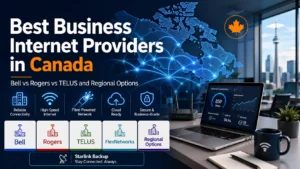
AI services also depend on reliable connectivity. Review your business internet requirements, compare business internet providers in Canada, and prepare for internet outages that could interrupt operations. A dedicated connection may be worth comparing for larger or latency-sensitive projects; see what a leased line can cost.
Three articles to build next
These should become the first supporting articles in the InternetAdvice.ca business section. They are listed without links until the pages are published, which avoids sending readers to unfinished URLs.
1. AI Data Residency in Canada: What Small Businesses Need to Check
Explain residency, processing location, sovereignty, PIPEDA, Quebec Law 25, contracts, subprocessors, and the exact questions to send a provider.
2. Private AI vs ChatGPT, Copilot and Gemini for Canadian Businesses
Help owners decide when a normal business subscription is enough and when a managed, private, or Canadian-hosted option is justified.
3. How to Build a Private AI Search Tool for Company Documents in Canada
Walk through document cleanup, permissions, retrieval, citations, testing, hosting choices, costs, and a practical pilot without pretending every company needs to train a model.
Frequently asked questions
Does a small business need an AI server?
Usually not. Finished business AI services and managed cloud platforms cover most office, document-search, and early application needs. An owned server becomes worth comparing only when sustained usage, privacy, latency, customization, or operational requirements justify the cost and expertise.
Does PIPEDA require business data to stay in Canada?
No blanket PIPEDA rule requires all business data to remain in Canada. Organizations remain accountable for personal information and must provide comparable protection when a third party processes it. Provincial law, sector rules, contracts, public-sector requirements, or company policy may impose stricter conditions.
Is a Canadian AI company automatically hosted in Canada?
No. Headquarters, ownership, storage location, processing location, support access, and subprocessors are separate facts. Ask for the exact data flow and contractual commitment.
Can employees put client information into ChatGPT, Copilot, or Gemini?
Do not assume they can. First confirm the business product and contract, the reason the data may be used, company policy, access controls, training and retention terms, location requirements, and any professional or sector obligations. Personal consumer accounts should not be the default route for confidential company work.
What is the difference between fine-tuning and document search?
Fine-tuning changes a model’s behaviour using examples. Document search retrieves relevant company material at the time of a question and gives it to a model as context. For facts that change, document retrieval is often easier to update and cite.
Should a Canadian business buy an H100 or H200 GPU?
Not as a first step. Rent compute, measure actual utilization, and compare the full cost of power, cooling, networking, storage, security, maintenance, and specialist time. A powerful GPU that sits idle is an expensive answer to the wrong question.
How this guide was researched
InternetAdvice.ca reviewed primary material from Canadian privacy and cybersecurity authorities, current provider documentation, and official Canadian compute-program pages. Provider claims are attributed to the provider and are not treated as independent certification. The page is designed to identify a sensible category to investigate, not to decide legal compliance or select a supplier. Products and regional availability can change; verify current terms before purchase. To report an error, missing Canadian option, or material product change, contact InternetAdvice.ca.
- Office of the Privacy Commissioner of Canada: Privacy and outsourcing for businesses
- Office of the Privacy Commissioner of Canada: Guidance on assessing third-party service providers
- Canadian privacy regulators: Principles for responsible, trustworthy and privacy-protective generative AI
- Commission d’accès à l’information du Québec: principal changes under Law 25
- Canadian Centre for Cyber Security: Generative artificial intelligence guidance
- Innovation, Science and Economic Development Canada: Canadian Sovereign AI Compute Strategy
This guide provides general information, not legal, privacy, cybersecurity, accounting, or procurement advice.