
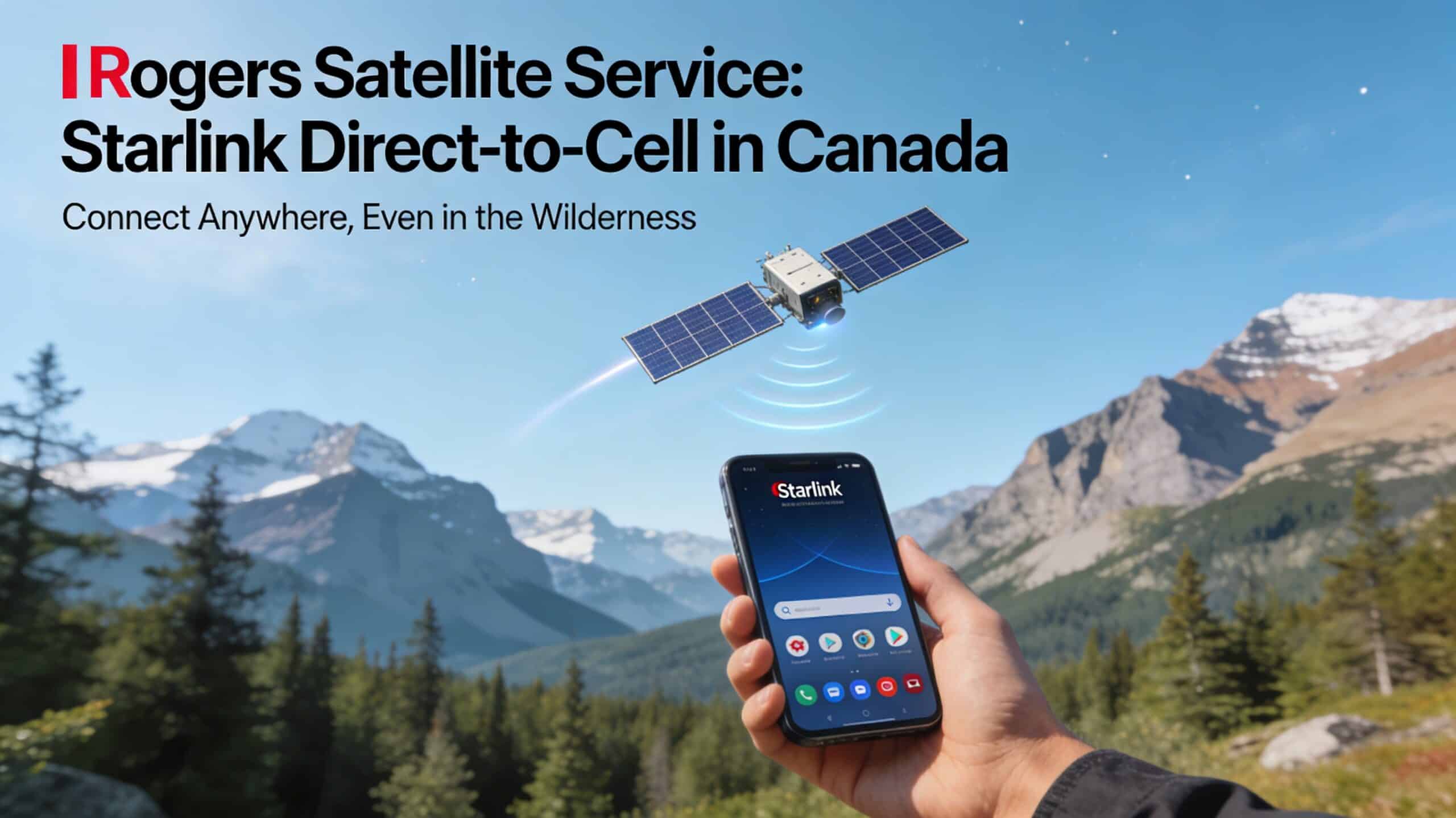
Starlink Direct to Cell Canada: Rogers Satellite Service Explained (2026)
Quick Facts: Rogers Starlink Satellite Service
| Launch Date | December 9, 2025 (Beta started July 2024) |
| Coverage Area | 5.4 million km² across Canada (2.5x any carrier) |
| Price | $15/month (FREE for Rogers Ultimate plan customers) |
| Current Features | SMS text messaging, App data (Maps, WhatsApp, X/Twitter) |
| Coming Soon | Voice calls, Full data access |
| Phone Compatibility | Works with existing 4G/5G smartphones (no special hardware) |
| Technology | Starlink Direct to Cell satellites (launched 2024-2025) |
What is Starlink Direct to Cell?
Starlink Direct to Cell is a groundbreaking satellite-to-smartphone technology developed by SpaceX that allows regular cell phones to connect directly to satellites orbiting 340 miles (547 km) above Earth. Unlike traditional satellite phones that require bulky special equipment, this service works with the smartphone you already own.
How It Works
SpaceX has launched specialized Starlink satellites equipped with cellular technology that acts like “cell towers in space.” When your Rogers phone loses connection to ground-based cell towers, it automatically connects to these satellites to provide coverage in remote areas.
The Technology:
- Satellite constellation: Dedicated Starlink satellites with cellular modems orbiting Earth
- Direct connection: Your existing 4G/5G phone connects directly—no dish or special hardware
- Automatic switching: Seamlessly transitions between tower and satellite coverage
- Clear sky requirement: Works best outdoors with unobstructed view of the sky
Current Features (As of February 2026)
SMS Text Messaging
Send and receive text messages anywhere in Canada, even in areas with no cell tower coverage. This is the core feature and works reliably for:
- Emergency communication in the wilderness
- Staying in touch while camping, hiking, or boating
- Remote work locations (forestry, mining, surveying)
- Cottage country with no cell service
App Data Support (Added December 2025)
Limited data access for essential apps including:
- Google Maps: Navigation and location services
- WhatsApp: Messaging and communication
- X (Twitter): Social media updates
- Other text-based apps (email, basic browsing)
Pricing & Plans
| Customer Type | Monthly Cost | Features Included |
|---|---|---|
| Rogers Ultimate Plan Customers | FREE (included) | SMS, App data, Future voice/data |
| Other Rogers Customers | $15/month add-on | SMS, App data, Future voice/data |
| Beta Participants (July-Dec 2025) | FREE during beta | SMS only initially, App data added Dec 2025 |
Coverage Map
Rogers satellite service covers 5.4 million square kilometers across Canada—an area 2.5 times larger than any Canadian carrier’s traditional cell network. This includes:
- Remote wilderness: National parks, backcountry hiking areas, Crown land
- Northern regions: Far northern communities, Arctic areas, territories
- Rural highways: Stretches of highway between towns with no cell towers
- Coastal areas: Offshore boating, fishing areas beyond cell range
- Cottage country: Remote lakefront properties without tower coverage
- Resource areas: Mining, forestry, and oil/gas operations in remote locations
Where It Works Best
For optimal performance:
- Outdoors: Clear view of the sky is essential
- Open areas: Away from dense tree cover or buildings
- Higher elevation: Hills and mountains work better than valleys
- Weather: Works in most conditions, but heavy storms may affect signal
Who Needs Rogers Satellite Service?
Essential Users:
- Outdoor enthusiasts: Hikers, campers, hunters, anglers who venture beyond cell coverage
- Remote workers: Surveyors, geologists, forestry workers, field researchers
- Cottage owners: Properties in areas with no traditional cell service
- Boaters: Sailing, fishing, or cruising beyond coastal cell range
- Emergency preparedness: Anyone who values backup communication in disasters
- Northern residents: Communities in territories and far northern provinces
- Road trippers: Driving remote highways (Trans-Canada northern routes, Alaska Highway, etc.)
- Adventure travelers: Wilderness tours, backcountry skiing, mountaineering
Optional for Most City Dwellers:
If you rarely leave urban/suburban areas with good cell coverage, you probably don’t need this service. However, it provides peace of mind for:
- Occasional camping or cottage trips
- Emergency backup during natural disasters
- Family members who frequently travel to remote areas
How to Activate Rogers Satellite Service
Step 1: Check Eligibility
You must be a Rogers mobile customer with an active plan. Service works with any modern smartphone (iPhone, Android) with 4G/5G capability.
Step 2: Add to Your Plan
Log into MyRogers app or account online, navigate to “Add-ons & Services,” and select “Satellite Service.” Rogers Ultimate plan customers receive it automatically at no charge.
Step 3: Update Phone Settings
Ensure your phone software is up to date. iOS and Android devices will automatically detect satellite connectivity when out of tower range—no special settings required.
Step 4: Test the Service
Before relying on it in the wilderness, test in your backyard or a nearby park to confirm it works. Send a text message and verify delivery.
Coming Soon: Voice & Full Data
Rogers and Starlink have announced that satellite service will expand to include:
Voice Calls (Expected 2026)
- Make and receive phone calls over satellite connection
- Quality may be lower than tower-based calls (expect some delay)
- Emergency calls (911) will be prioritized
- Same $15/month price (included for Ultimate customers)
Full Data Access (Timeline TBD)
- Internet browsing beyond just apps
- Email with attachments
- Social media (all platforms)
- Potentially video streaming (bandwidth permitting)
- Pricing may change when full data is available
Rogers Satellite vs Traditional Satellite Phones
| Feature | Rogers Satellite Service | Traditional Sat Phones (Iridium, Inmarsat) |
|---|---|---|
| Monthly Cost | $15 (or free) | $50-150+ |
| Equipment Cost | $0 (use existing phone) | $500-1,500+ (special satellite phone) |
| Phone Required | Any Rogers smartphone | Dedicated satellite phone |
| Voice Calls | Coming soon (2026) | Yes (available now) |
| Text Messaging | Yes | Yes |
| Data Access | Limited apps (expanding) | Very slow, expensive data |
| Coverage | 5.4M km² Canada | Global (including oceans) |
| Ease of Use | Automatic, seamless | Manual switching, bulky device |
| Best For | Casual remote use, backup | Professional remote work, maritime |
When to Choose Traditional Sat Phones:
- Need voice calling RIGHT NOW (Rogers voice coming later)
- Traveling internationally outside Canada
- Maritime/ocean use (beyond Canadian territorial waters)
- Professional expeditions requiring guaranteed communication
- Not a Rogers customer and don’t want to switch
Real-World Use Cases
Case Study 1: Backcountry Hiking
Scenario: Sarah is hiking the West Coast Trail in British Columbia, a 7-day trek with zero cell coverage.
Solution: With Rogers satellite service, she sends daily “I’m OK” texts to family and uses Google Maps to verify her location along the trail. In case of injury, she could text for emergency help.
Case Study 2: Remote Work Site
Scenario: Mike works as a surveyor in northern Alberta, often spending weeks at remote mining sites with no cell towers for 100+ km.
Solution: He uses satellite SMS to coordinate with his office, receive work orders via WhatsApp, and stay in touch with family. Previously required a $1,200 Iridium phone costing $100/month.
Case Study 3: Cottage Getaway
Scenario: The Johnson family cottage on a remote Ontario lake has never had cell service, forcing them to drive 30 minutes to town to make calls.
Solution: All family members with Rogers phones can now text each other and use Google Maps to navigate from town. Coming voice capability will eliminate the “drive to town” trips entirely.
Case Study 4: Highway Emergency
Scenario: David’s car breaks down on a remote stretch of Highway 11 in northern Ontario during winter, in an area with no cell coverage.
Solution: He uses satellite SMS to text his wife his GPS location from Google Maps. She contacts roadside assistance with his exact coordinates. Potentially life-saving in -30°C weather.
Limitations & Considerations
What Rogers Satellite Service CANNOT Do (Yet):
- Video calls: Not enough bandwidth for FaceTime, Zoom, etc.
- Video streaming: Netflix, YouTube won’t work
- Large file transfers: Can’t send/receive photos via text, large email attachments
- Real-time gaming: Latency too high for online gaming
- Indoor use: Requires line-of-sight to sky, won’t work inside buildings
- Dense forest: Heavy tree cover significantly degrades signal
- Instant delivery: Texts may take 30 seconds to several minutes (vs. instant on towers)
Technical Limitations:
- Latency: 1-3 second delay due to satellite distance (vs. instant tower connection)
- Battery drain: Satellite connection uses more power than towers
- Weather sensitivity: Heavy rain, snow, or storms can interrupt service
- Positioning: Phone must be held relatively still with screen facing sky
- Shared bandwidth: Service may slow if many users in one area
Pros and Cons
Advantages
- Works with your existing smartphone (no special hardware)
- Affordable ($15/month or free with Ultimate plans)
- Massive coverage (5.4M km² across Canada)
- Automatic connection (no manual switching)
- Emergency safety net in remote areas
- App data support (Maps, WhatsApp, X/Twitter)
- Voice and full data coming soon
- No contracts or long-term commitments
Disadvantages
- No voice calls yet (coming 2026)
- Limited to text and basic app data currently
- Requires Rogers mobile plan (not available standalone)
- Must be outdoors with clear sky view
- Slower delivery than traditional cell towers
- Battery drain higher than normal cell use
- Weather can affect signal quality
- Dense forest/buildings block signal
Comparison: Rogers Satellite vs Other Options
| Service | Monthly Cost | Coverage | Best For |
|---|---|---|---|
| Rogers Satellite | $15 (or free) | Canada wide | Casual remote use, emergency backup |
| Starlink Roam (RV) | $189/month | North America | RVers, mobile workers needing full internet |
| Iridium Satellite Phone | $80-150/month | Global | Professional expeditions, maritime |
| inReach (Garmin) | $15-65/month | Global | Hikers, adventurers (text only, no calls) |
| SPOT Satellite Messenger | $15-30/month | Global | Emergency SOS only, basic tracking |
Frequently Asked Questions
Do I need a special phone or app?
No. Any modern Rogers smartphone with 4G/5G capability works automatically. No special app or settings required.
Will it work with my iPhone?
Yes, both iPhone and Android devices are supported. Ensure your phone’s software is up to date.
Can I use it inside my cottage or cabin?
No, satellite service requires line-of-sight to the sky. You must be outdoors with a clear view overhead.
How fast are text messages delivered?
Expect 30 seconds to several minutes for delivery, depending on satellite position and network conditions. Not instant like traditional cell towers.
Can I send photos via satellite text?
Not currently. Only text-only SMS is supported. Photo/video messaging requires too much bandwidth.
What happens if I travel outside Canada?
Rogers satellite service only works within Canada. Use traditional roaming when traveling internationally.
Is there a data cap on app usage?
Rogers hasn’t specified hard data limits, but the service is designed for “essential apps” not heavy usage. Expect restrictions on bandwidth-intensive activities.
Can I cancel anytime?
Yes, it’s a monthly add-on with no contract. Cancel anytime through MyRogers.
Does it work in bad weather?
Light rain and snow are generally fine, but heavy storms may interrupt service temporarily. Similar to home satellite TV.
Can I use it on a boat or airplane?
Boats: Yes, if within Canadian territorial waters and you have clear sky view. Airplanes: No, service is not designed for high-speed aviation use.
Bottom Line
Rogers satellite service powered by Starlink Direct to Cell is a game-changer for Canadian connectivity. For just $15/month (or free with Ultimate plans), you get SMS texting and essential app access across 5.4 million square kilometers of remote Canada—coverage no traditional carrier can match.
While current capabilities are limited (no voice calls yet, no photo/video sharing, outdoor-only use), the service already provides invaluable emergency communication and peace of mind for anyone venturing beyond cell tower range. The upcoming addition of voice calls in 2026 will make it even more compelling.
Should you get it? If you’re a Rogers customer who regularly travels to remote areas—camping, cottage trips, backcountry adventures, or remote work sites—this is a no-brainer at $15/month. It could literally save your life in an emergency. For Ultimate plan customers, it’s free, so there’s zero reason not to activate it.
For city dwellers who rarely leave urban areas, it’s optional but provides emergency backup during natural disasters when cell towers fail. At this price point, it’s affordable insurance for staying connected when it matters most.
Share Your Rogers Satellite Experience
Have you used Rogers satellite service in remote areas? Share your experience to help other Canadians decide if it’s right for them.